Anyone setting off on a sailing holiday knows that they will face several journeys, sometimes lasting many hours, at an "obligatorily slow" speed, which, however, could be ideal for casting a few lines and relaxing in the hope that a good strike will brighten up the navigation.
Of course, we're not talking about a purely fishing boat with 10 rod holders available, outriggers, and a large cockpit clear of clutter, but quite the opposite: often sailing boats have limited space, with dozens of ropes ready to trip us up and prevent quick movements (especially with a fish on the line) from one side to the other, the ability to fix a minimal number of rod holders, and above all, poor maneuverability.
Let's also add that often we travel in groups, and it's not "polite" to fill common areas with so much heavy and bulky equipment, perhaps leading to some complaints from our partner, and we end up giving up entirely, deciding to settle for a holiday without fishing.
But imagine the suffering of being forced to sail for hours and hours at ideal trolling speeds, without even a single line in the water? So, having ruled out the idea of being persuaded to leave our rods at home (the fishing ones), let's make the most of our crossings to charm the entire crew with some nice fish for dinner!

Let's prepare the boat...
Let's start by understanding what space the boat offers us for fixing rod holders (which will necessarily be rail-mounted) and possibly plan to install at least 2, one on the right and one on the left, preferably with the possibility of orienting them outwards to gain a few more meters in width and possibly make the baits work outside the wake. If the boat has few obstacles at the stern (gangway, auxiliary tender engines, tender under tow, etc.), we can possibly consider installing some other central rod holders, to reach 4 lines in the water which, in my opinion, is the ideal quantity. Although there will certainly be no shortage of them on a sailboat, don't forget to bring some small ropes with snap hooks to secure the fishing rods.

...and our equipment!
Speaking instead of what we might need, considering fishing with 4 rods, my advice is to prefer 30 lb rod and reel combos for offshore fishing. I wouldn't go below 30 lb due to the reel's capacity, because we might have to manage the run of a large fish and not be able to maneuver the boat quickly to close the distance, especially if we are sailing. So a few hundred extra meters could be useful.
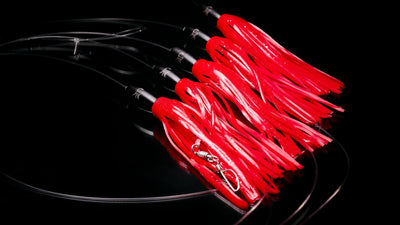
In the bag, we'll put: several konas, to be able to cast the most suitable bait for the speed that the wind and the boat impose on us, as well as the weather conditions; some release clips or elastic bands which I will explain later what they will be for; teasers, Daisy Chains and various attractants that we will use to stir the water a bit during silent sailing; obviously also all the accessories such as spare hooks, various rigs, nylon, snap hooks, pliers and small useful items for any eventuality; for the gaff, choose to bring a very long one (the sides of sailboats are very high) and robust, therefore preferably non-telescopic, and don't forget a fighting belt.

On the pelagic route
Obviously, being in the open sea, our prey will be the usual offshore pelagics. In shallower waters, we will have good chances of catching imperial needlefish, dolphin fish and tuna species, such as little tunny, albacore and bluefin tuna, while in the deep blue sections, in addition to albacore and bluefin tuna, we might be lucky enough to encounter some beautiful specimens of swordfish.
Having to reach a destination by drawing a straight line, we certainly won't have too many opportunities to concentrate and insist on certain depths, but if we notice a floating object adrift, it's definitely worth making a small detour to pass close to it.

Let's choose the right setup
We've finally left the port. If the wind is right, we'll have hoisted the sails, otherwise we'll be content with motoring. In both cases, the speed will certainly be in the right range and several hours of navigation await us... it's time to cast our lines.
To choose baits and setup, the most important factor to check is precisely the speed: if it is between 5 and 6.5/7 knots, the choice will preferably fall on konas such as the Cube, the Jet Monkey, the Bullet and the Bullet Reverse, while if the speed should exceed 7 knots up to 8/9 knots, in addition to the konas already mentioned, we can also consider the Albacore Tube, the Spearfish Master and the Fat Monkey.
Since, in the case of sailing, the wind will obviously also be significant, perhaps lateral, the line of the cast baits could create a large belly, even displacing the baits with the risk of them getting tangled. At this point, an optimal solution could be to add heavy teasers such as Flippy Monkey or Squid Chain to all rods, so as to have the line tighter and, at the same time, always keep the position of each bait under control. In case of really strong wind, it might also be necessary to shorten all the lines.
Once all the lines are cast, all that remains is to relax and enjoy the magnificent scenery of the open sea, which could offer us the sight of playful dolphins accompanying us for a while, swimming and jumping alongside the bow... waiting for the silence of sailing to be interrupted by the sound of a strike.

Managing a strike
As I said at the beginning, a sailboat does not have the maneuverability of a fisherman, and, especially if we are sailing, it can be really complicated to manage a strike and land the catch.
When a rod strikes, we should try to understand if it is a tuna of not excessive size that can be safely pumped and brought alongside with our 30 lb gear without needing to retrieve the other rods and make turns, or a larger fish, or, even worse, a billfish. In these latter cases, we will need to retrieve the other rods and assist the retrieve with the boat.
When sailing, the first fundamental actions that the helmsman must take are: start the engine, lower the sails, and maintain course at minimum speed. Meanwhile, the other rods must be retrieved as quickly as possible, ensuring that the striking rod always has tension on the line.
At this point, the fight can begin, which will be aided by wide turns of the boat, trying to keep the fish always on the same side of the hull and avoiding sudden movements from one side to the other, which could be quite problematic, especially in rough seas. Pay close attention to the final stages with the fish alongside, because a run under the boat would almost certainly mean breaking the line.