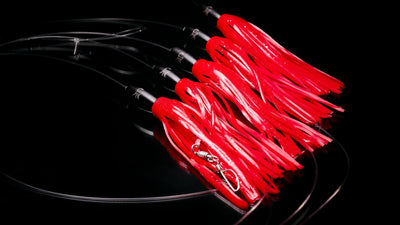
Offshore trolling is increasingly captivating enthusiasts, who are eager to venture offshore, cast their rods, and relax with a gentle breeze, hoping that the sound of the alarm will break the peace and initiate a team effort from the entire crew, ready to sweat to bring the catch alongside.
Of course, fishing conditions are not always so idyllic. In fact, often, you will find yourself facing rough seas and wind which, combined, can be quite annoying, or there might be days when the only "noise" that will interrupt the peace of fishing will be the ringtone of your cell phone, ready to ring in those few spots where there is network coverage! But we are fishermen, and no impediment or adverse conditions will deter us from the goal of a dream catch that offshore trolling in the Mediterranean can still offer.
It is not an easy technique, nor is it cheap, especially for those who intend to practice it consistently and "professionally" to ensure that a catch is sought after, the result of a job well done, and not accidental. At the same time, it is equally true that it leaves room for a series of improvisations that allow those who, without too many pretensions, want to cast some lines in the water during their trip from point A to point B, to have the good fortune of finding themselves fighting an unexpected prey and even landing it. Usually, these fishermen are aware that it will not be so easy to repeat that catch, while the former are those who, by analyzing the dynamics that led to the strike, will treasure that experience and will try to do even better in the future.

Trolling season
It is often thought that the season coincides and is limited only to the warmer months of the year, i.e., July and August, but I must confess that as early as April it is worth starting to try, and that catches can extend, depending on the weather conditions, even until November.
However, during the summer months, we are definitely at the peak, with all pelagic fish active, from imperial needlefish, to schooling tuna and tunnies in general such as albacore and bonito, to dolphinfish, without excluding the possibility, albeit rare, of encountering a swordfish.

Setting up the boat
I will never tire of saying it, "offshore" does not necessarily mean venturing tens of miles from the coast, but rather going where there are depths and bathymetric cuts that allow the passage or presence of pelagic fish. To be clearer, if, for example, two miles from the coast in our area we had a depth of 2/300 meters, we would not necessarily need to go further.
I made this small premise to reassure anyone who wants to start this technique, even if they don't have a large fishing boat. Of course, I can't tell you that offshore fishing with a 6-meter open boat is the same as a 12-meter cabin cruiser, which might allow you to go out in any sea conditions, but with the right setup, I assure you that even a medium/small boat or even an inflatable boat, performs admirably.
An offshore boat must allow us to fish with at least 4 rods... some even go up to 10, but in my opinion, it makes no sense and I believe that the limit, as well as the ideal number, is 6/7 rods. So, depending on the space on the gunwale and the presence or absence of t-top/rollbar, we will position our rod holders. I advise you to install at least one in the center of the boat, at the highest point, which will be used for the long center rod. On the gunwale, however, four rod holders will be sufficient, two per side, with different inclinations: the two towards the stern with an inclination parallel to the direction of travel, the other two oriented between 30 and 45°. A pair of outriggers is essential, while a center outrigger would be a valuable aid and would replace the rod positioned high on the t-top.

Lures and tackle
The topic of "tackle" is slightly more complex because it is influenced by both the personal preference of the angler, as in the choice between roller and ringed rods, and the type of setup desired regarding line class.
In a setup specifically aimed at billfish, it will be difficult to use very light rods because they would tend to flex a lot under the pull of large konas, trolled at sustained speeds, and then slingshot the lure forward when it comes out of the water for its natural action. Konad lures, in this way, do not work correctly, but that is not the only problem: at the time of the strike, we will need to penetrate, with hooks of a certain size, very hard parts of a billfish's mouth, and a soft rod combined with a light reel may not always meet this need. The only two rods that, in my opinion, can be lighter, are those on the outriggers, because the outriggers do all the work, both of the lures and of the strike.
When fishing for tuna, however, by finding the right compromise between rod and kona so that the latter works correctly, we could also go down in line class.
That said, I realize that gearing up with 6 combos can be quite expensive, let alone thinking of buying double the tackle to change it depending on the setup you choose.
In making your choice, it is important to know that even topshot rods, spooled with braid, will need a shock leader of at least 60-70 meters of monofilament. Reels must be able to hold at least 600 meters of main line and have a very fast retrieve ratio, with a very smooth and precise drag, preferably double speed.
As for lures, we will need a considerable stock of different konas, both in type (bullet, jet, tube, 45° cut) and in size and color. It is also very important to have some single teasers or daisy chains, which often make all the difference! A couple of fighting belts, a good pair of gloves, and a long, solid gaff complete the list of strictly necessary equipment.

Prey and setups
So, we've established that there can be multiple offshore setups (also called spreads): depending on the boat, the type of fish you want to catch, weather and sea conditions, etc. There are setups primarily for tunnies, setups strictly for billfish with a further distinction between swordfish and imperial needlefish, and mixed setups.
When targeting tunnies, the lures we will mostly use are jet konas (Jet Monkey, Cube, Fat Monkey) and some Bullet (without neglecting the Spearfish Master, despite its size), all lures that do not require high speeds to work well, but rather speeds between 6 and 7 knots. I would deploy two rods on the outriggers at about 50 meters, a long center rod at about 80/100 meters, and the remaining two flat lines in the wake between 20 and 30 meters. The addition of teasers (especially the Mud Mirror, but also the Flippy Monkey), on at least two rods, is highly recommended.
If we want to target a billfish, instead, we will set the speed at about 8 knots. In this case, I would deploy a first center rod on the shotgun at about 100 meters with a jet (Jet Monkey or Cube, combined with a Flippy Monkey or Squid Chain teaser) or with a bullet (Bullet or Spearfish Master), two rods on the outriggers at about 50/60 meters (Jet Monkey, Cube, preferably combined with a Mud Mirror, Flippy Monkey or Squid Chain teaser), two flat lines in the wake at 30/40 meters (Bullet, Albacore Tube, Bullet Reverse, Cube, Fat Monkey) and a last center rod at about 15/20 meters (Cube, Heavy Jet, Fat Monkey).
Obviously, these are just general guidelines, because everyone will have to consider their own boat, the position and number of rod holders, the weather and sea conditions of that day, and find their ideal spread that allows the lures to work well, being able to navigate and make turns without the risk of tangling the lines.

Fishing action
Being literally in the middle of the sea, with no reference points, the simplest conclusion might seem to wander aimlessly, but nothing could be further from the truth.
It is of fundamental importance to study the nautical chart, to look for bathymetric cuts, canyons, and everything that can create currents, but also at sea we must always keep our eyes open, scanning the surface for current lines (clearly visible due to the difference in water ripple), or feeding frenzies, gulls resting or flying low, floating debris such as large logs, piles of algae, mattresses, etc. These are all signs that we must seize to make passes in the vicinity.
As for bathymetrics, however, I always prefer to set up the fishing by following them parallel, and then, once an area of interest is found, work it by cutting across them and making turns.

Strike!
Even strike management depends on the type of fish, because in the case of tunnies, the ideal is to slow down slightly, continuing straight ahead, and fight the fish by retrieving only the shorter rods, those between the fish and the boat, to prevent them from getting tangled.
When dealing with billfish, however, the situation gets a little more complicated, as all other rods must be retrieved before starting the fight, which should be managed by trying to close the distance, helping ourselves with the boat to quickly reel in and gain meters, until the fish is brought to a safe distance of about 20/30 meters. At that point, we can also force it more, pumping it to bring it alongside, but paying attention to any restarts and jumps, thanks to which it could unhook itself.
Although I have included a gaff in the necessary equipment, I consider the release of some prey, such as imperial needlefish, much more rewarding than keeping them. In this case, with gloves, firmly grasp them by the bill and take the ritual photos with the fish in the water, avoiding lifting it aboard to avoid causing trauma, and release it with the hope that in the future it can make us experience such a great emotion again!

Offshore instrumentation
An offshore boat obviously also needs electronics that can meet the needs related to this technique. Specifically, an instrument with a screen size such that both chartplotter and fishfinder are clearly visible simultaneously, or possibly two separate screens. All coupled with a transducer of at least 1kW, given the depths we will be operating in.
Another very important ally is the autopilot, since we will spend up to 8/10 hours navigating, and constantly correcting the course with a hand on the helm can be tiring, not to mention that in the event of a strike it will be like having an extra person on board.
My advice is to always use the "track" function of navigation, so as to always keep under control the areas already covered and to be able to make precise turns when we go to work the areas. Furthermore, in case of a strike or fish signal, it is always convenient to mark that point both to insist on it during that day, and to have reference points on which to set the course depending on the time of year. You will see, with the increase of waypoints on the chart, that real hot spots will be created with strikes concentrated in certain points depending on the season.
As for the fishfinder, it can be useful both for monitoring the possible presence of large fish lying deep that could, however, rise towards our lures by insisting on that spot, and for possible schools of baitfish.